 Armstrong Pumps
 Bell & Gossett
 Taco Pumps
 Goulds Water Technology
 Grundfos Pumps
 Wilo & Scot Pumps
 Boilermag XT magnetic filter
 Circulator Pumps
 Hoffman Specialty
 John Crane
 McDonnell & Miller
 Heat Exchangers
 B&G Power Packs
 Weg Motors
 TechTop Motors
 US Motors & Nidec
 Baldor Motors
 SKF Motor Bearings
 Motor Repairs
 Armstrong
 Hoffman Specialty
 SKF Bearings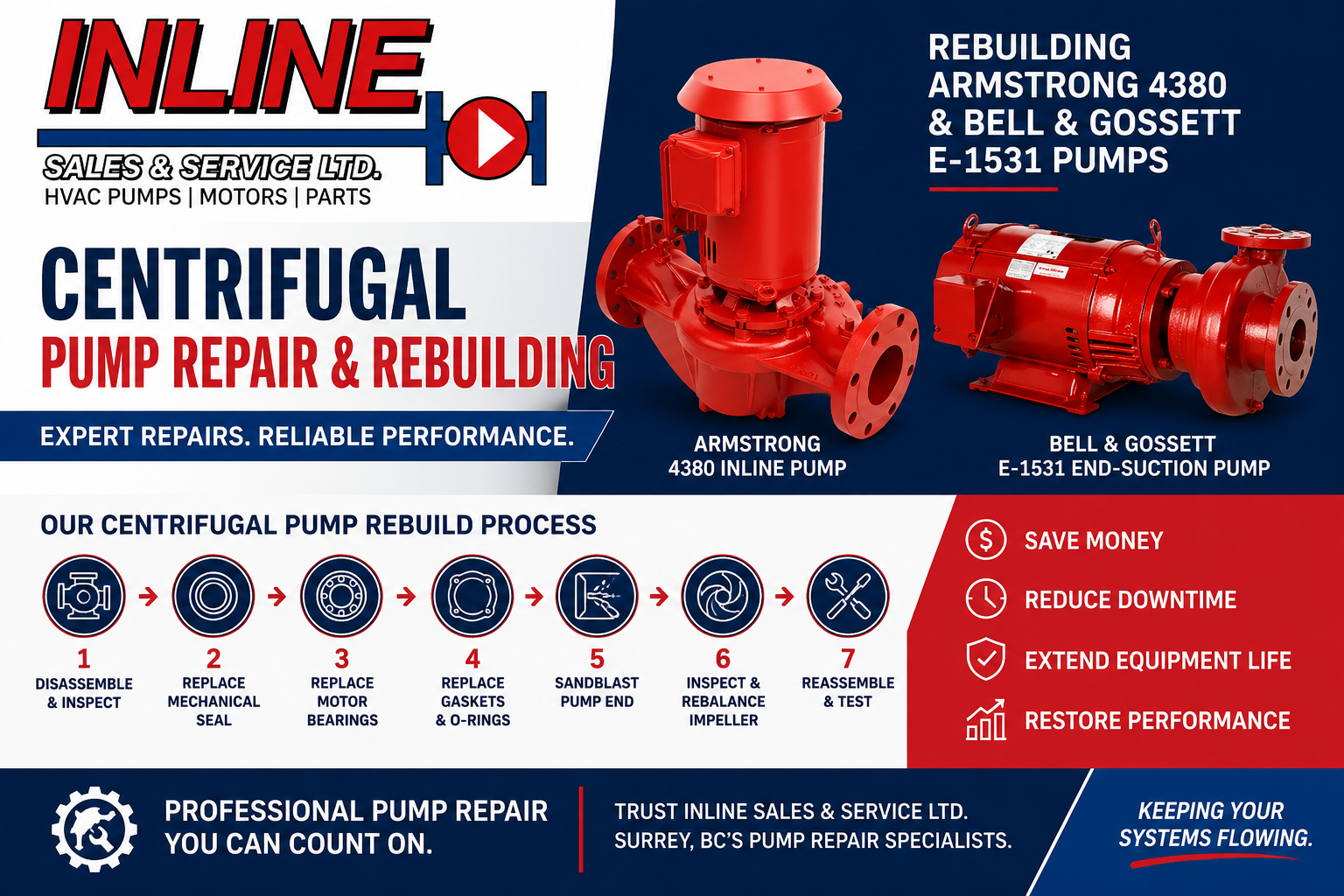
Centrifugal Pump Repair & Rebuilding: Inside the Inline Sales & Service Shop
When a centrifugal pump starts showing signs of wear, replacement is not always the best solution. In many commercial HVAC, hydronic and industrial applications, a properly rebuilt pump can restore reliable performance while saving the customer the cost and downtime associated with purchasing a new pump.
At Inline Sales & Service Ltd., we specialize in centrifugal pump repair and rebuilding. Our experienced technicians work on a wide range of commercial pumps, including Armstrong and Bell & Gossett pumps, rebuilding them in our Surrey, BC shop.
Recently, we rebuilt both an Armstrong 4380 inline pump and a Bell & Gossett E-1531 end-suction pump. While each pump has its own design and repair requirements, the fundamental goal is the same: inspect every component, replace worn parts, restore the pump end and impeller, and return the pump to dependable operating condition.
What Is Involved in Rebuilding a Centrifugal Pump?
A quality pump rebuild involves much more than simply replacing the mechanical seal. When a pump comes into our shop, we take the time to inspect the entire assembly to determine what caused the problem and what components need to be restored or replaced.
Depending on the condition of the pump, a typical rebuild can include:
Disassembling the pump
Inspecting the shaft, impeller and pump casing
Replacing the mechanical seal
Replacing gaskets and O-rings
Sandblasting and cleaning the pump end
Inspecting and repairing the impeller
Checking and rebalancing the impeller
Reassembling the pump
Testing the completed assembly
This process helps ensure that the pump is not simply repaired to get it running again, but is rebuilt to provide reliable service for the future.
Step 1: Disassembling and Inspecting the Pump
The first step is carefully disassembling the pump and inspecting each component.
With an Armstrong 4380 inline pump, our technicians inspect the motor, shaft, impeller, casing and mechanical seal. Inline pumps are commonly used in commercial HVAC and hydronic systems, where reliable circulation is critical to maintaining proper system performance.
For a Bell & Gossett E-1531, the pump is an end-suction design. These pumps are widely used in commercial and industrial applications, and their construction allows our technicians to service individual components rather than automatically replacing the entire pump.
During disassembly, we look for signs of:
Bearing wear
Seal leakage
Shaft damage
Corrosion
Impeller wear
Gasket deterioration
Casing damage
Rust and scale buildup
Finding these issues before reassembly is an important part of doing the job correctly.
Step 2: Replacing the Mechanical Seal
One of the most common components to fail on a centrifugal pump is the mechanical seal.
The mechanical seal prevents water or system fluid from leaking along the pump shaft. Over time, the seal faces can wear, become damaged or lose their ability to maintain a proper seal.
When rebuilding a pump, we remove the old seal and carefully inspect the shaft and seal mounting surfaces before installing the new component.
Proper installation is critical. A new mechanical seal can be damaged during installation if it is handled incorrectly or if the shaft and mating surfaces are not properly prepared.
Replacing the seal during a rebuild helps prevent the pump from returning to service only to develop another leak shortly afterward.
Step 3: Replacing Motor Bearings
Motor bearings are another important component we inspect during a pump rebuild.
Bearings support the motor shaft and allow it to rotate smoothly. As bearings wear, they can create excessive noise, vibration and heat. Eventually, a failed bearing can damage the motor or affect the alignment of the pump assembly.
During the rebuild, worn motor bearings are removed and replaced with new bearings.
Replacing the bearings while the pump is already apart can be a cost-effective way to extend the life of the equipment and avoid having to take the pump out of service again due to a bearing failure.
Step 4: Replacing Gaskets
Gaskets are often overlooked, but they play an important role in keeping a centrifugal pump properly sealed.
Whenever a pump is disassembled, existing gaskets can become compressed, damaged or unable to reseal properly. We replace the necessary gaskets during the rebuild rather than relying on old sealing surfaces.
New gaskets help prevent leaks and ensure that the pump casing and associated components are properly sealed when the pump is returned to service.
Step 5: Sandblasting the Pump End
After years of operation, pump casings and other components can develop rust, corrosion, scale and buildup.
As part of the rebuilding process, we can sandblast the pump end to remove corrosion and accumulated material.
This provides several benefits:
Removes surface corrosion
Cleans the casting
Improves the appearance of the pump
Makes it easier to identify damage
Provides a clean surface for inspection and refinishing
Once the pump end has been cleaned, our technicians can get a much better look at the condition of the casting and determine whether additional repairs are required.
For commercial equipment that has been in service for many years, restoring the pump end can make a significant difference in the overall condition of the rebuilt pump.
Step 6: Inspecting and Rebalancing the Impeller
The impeller is one of the most important components inside a centrifugal pump. It is responsible for transferring energy from the rotating shaft into the fluid and generating the pump’s flow and pressure.
Impellers can become damaged or worn over time due to corrosion, cavitation, debris or normal operation.
During a rebuild, we inspect the impeller for signs of damage and wear. If necessary, the impeller can be repaired before being returned to service.
We also rebalance the impeller as part of the rebuilding process.
An improperly balanced impeller can contribute to vibration, premature bearing wear, mechanical seal problems and excessive stress on the pump and motor.
Proper balancing helps the rotating assembly operate more smoothly and can improve the overall reliability of the rebuilt pump.
Step 7: Reassembly
Once the individual components have been inspected, repaired and replaced, the pump can be reassembled.
For the Armstrong 4380 and Bell & Gossett E-1531, this includes installing the rebuilt components, new seals, bearings and gaskets and carefully putting the pump assembly back together.
Attention to detail during reassembly is extremely important. Proper component installation, shaft condition, impeller position and mechanical seal installation all contribute to the final performance of the pump.
Why Rebuild a Centrifugal Pump?
There are several reasons why rebuilding an existing pump can make sense.
Save Money
Depending on the pump and the condition of the existing equipment, rebuilding can be considerably more economical than purchasing a complete replacement pump.
Reduce Downtime
A repair can often get an existing pump back into service faster than sourcing a completely new pump, particularly when replacement equipment has a long lead time.
Extend Equipment Life
Replacing worn bearings, seals and gaskets while restoring the pump end and impeller can give an older pump many more years of useful service.
Keep Existing Piping
Replacing a pump can sometimes involve changes to piping, flanges, dimensions, electrical connections or system components. Rebuilding the existing pump allows the customer to keep the existing installation in place.
Restore Performance
A worn seal, damaged impeller, failing bearings or corrosion can all affect pump performance. Rebuilding the pump addresses these issues and helps restore the equipment to proper operating condition.
Armstrong 4380 & Bell & Gossett E-1531 Pump Repair
The Armstrong 4380 and Bell & Gossett E-1531 are examples of the types of centrifugal pumps we can rebuild in our shop.
Whether the pump needs a simple mechanical seal replacement or a complete rebuild involving bearings, gaskets, impeller work and pump-end restoration, our technicians can inspect the equipment and determine the most practical repair solution.
At Inline Sales & Service Ltd., we don’t believe in automatically replacing equipment when it can be properly repaired. Our goal is to provide customers with a reliable, cost-effective solution that keeps their HVAC, hydronic or industrial systems operating.
Need a Pump Repaired?
If you have a centrifugal pump that is leaking, noisy, vibrating, overheating or simply not performing like it should, bring it to Inline Sales & Service Ltd. in Surrey, BC.
Our shop provides centrifugal pump repair, motor repairs, mechanical seal replacement, impeller inspection and balancing, pump rebuilding and other pump services for customers throughout the Lower Mainland and Fraser Valley.
Before replacing an expensive pump, let our team inspect it. A rebuild may be all you need to get your pump back in service and keep your system flowing.