
 Armstrong Pumps
 Bell & Gossett
 Taco Pumps
 Goulds Water Technology
 Grundfos Pumps
 Wilo & Scot Pumps
 Boilermag XT magnetic filter
 Circulator Pumps
 Hoffman Specialty
 John Crane
 McDonnell & Miller
 Heat Exchangers
 B&G Power Packs
 Weg Motors
 TechTop Motors
 US Motors & Nidec
 Baldor Motors
 SKF Motor Bearings
 Motor Repairs
 Armstrong
 Hoffman Specialty
 SKF Bearings
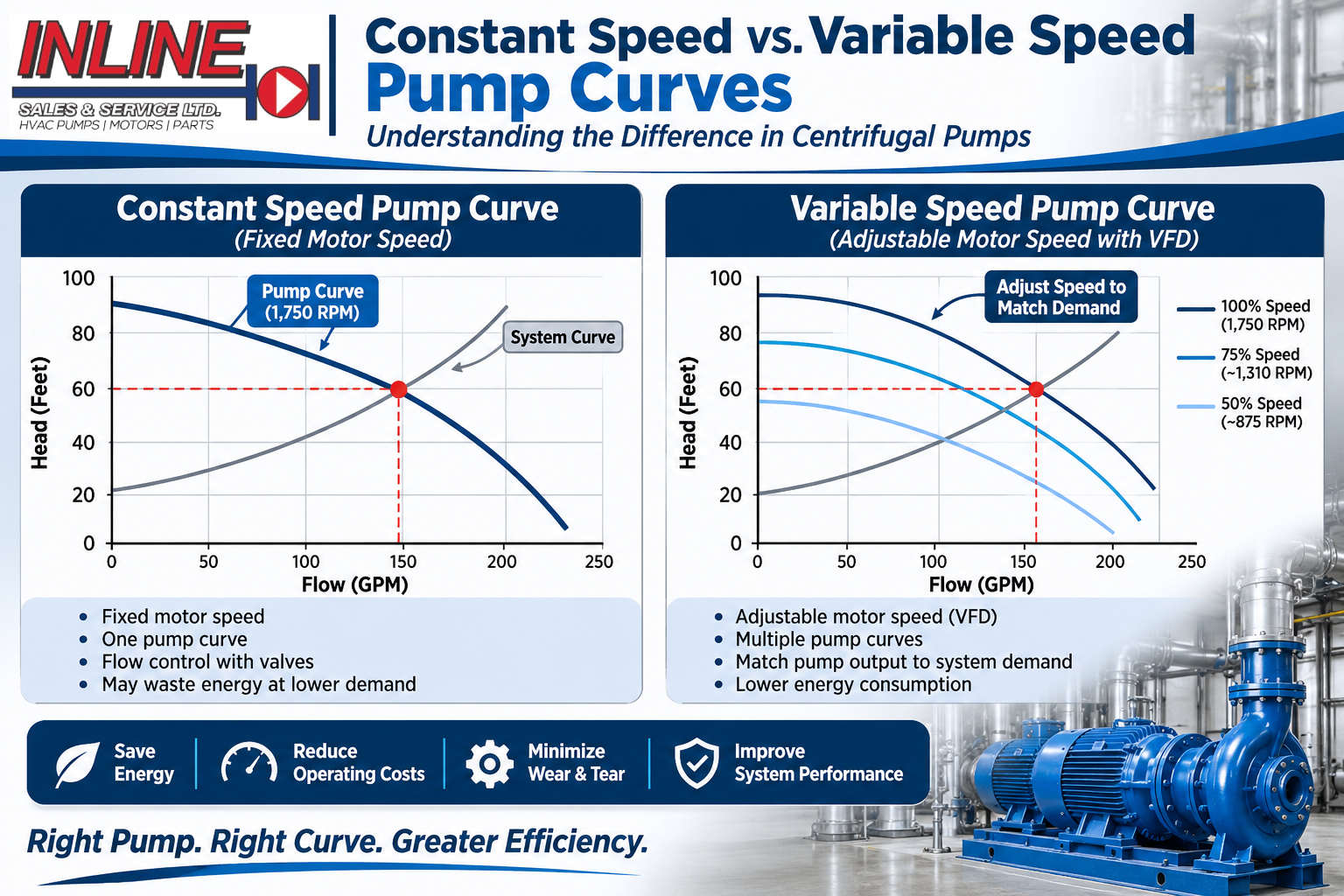
Constant Speed vs. Variable Speed Pump Curves: Understanding the Difference in Centrifugal Pumps
When selecting, operating, or maintaining a centrifugal pump in a commercial building, understanding pump performance curves is essential. One of the most important distinctions is the difference between a constant speed pump curve and a variable speed pump curve.
Both curves help determine how a pump will perform under different operating conditions, but they represent different ways of controlling pump output. Understanding how they work can help building operators, mechanical contractors, and engineers improve system efficiency, reduce energy consumption, and extend equipment life.
At Inline Sales & Service Ltd., we work with centrifugal pumps from leading manufacturers, including Bell & Gossett, Armstrong, Grundfos, and Goulds. Understanding pump curves is an important part of selecting the right pump for each application.
1. What Is a Constant Speed Pump Curve?
A constant speed pump curve represents the performance of a centrifugal pump operating at a fixed motor speed, typically 1,750 RPM or 3,500 RPM when using a 60 Hz power supply.
The curve illustrates how the pump’s flow rate and discharge head change as the system demand changes while the pump continues operating at the same speed.
Key characteristics of a constant speed pump:
-
The motor operates at a fixed RPM.
-
The pump follows one primary performance curve.
-
Flow and head are determined by the intersection of the pump curve and the system curve.
-
Throttling valves can be used to restrict flow, but the motor continues operating at full speed.
-
Excess pump capacity may be wasted when system demand decreases.
For example, a commercial building may require 200 US GPM during normal operation. If the building’s demand drops to 120 US GPM, a constant speed pump may continue operating at full speed, with a control valve restricting flow to meet the reduced demand.
This means the pump may be producing more pressure than the system actually needs, resulting in unnecessary energy consumption.
2. What Is a Variable Speed Pump Curve?
A variable speed pump curve represents how a centrifugal pump performs when its motor speed is adjusted using a Variable Frequency Drive (VFD).
Instead of operating at one fixed RPM, the VFD changes the motor frequency to increase or decrease pump speed based on system requirements.
As the pump speed decreases, the pump produces less flow and less head. As speed increases, the pump produces more flow and head.
This creates a series of performance curves, with each curve representing a different operating speed.
Key characteristics of a variable speed pump:
-
Motor RPM can increase or decrease based on demand.
-
Multiple pump curves represent different operating speeds.
-
Flow and head can be adjusted to match actual system requirements.
-
Energy consumption can be significantly reduced at lower operating speeds.
-
Reduced operating speed can help minimize mechanical wear and system stress.
For example, if a commercial building only requires 120 US GPM instead of 200 US GPM, a VFD can slow the pump down rather than relying on a throttling valve to restrict flow.
The pump can then operate closer to the actual system demand, potentially saving a considerable amount of energy.
3. Understanding the Affinity Laws
One of the most important concepts when comparing constant speed and variable speed pump operation is the centrifugal pump affinity laws.
These laws explain the relationship between pump speed, flow, head, and horsepower.
When the impeller diameter remains unchanged:
Flow (GPM)
Flow changes proportionally with pump speed.
A 10% reduction in speed results in approximately a 10% reduction in flow at corresponding points on the pump curves.
Head (Pressure)
Head changes proportionally to the square of the speed.
A 10% reduction in pump speed results in approximately a 19% reduction in head.
Horsepower (Energy Consumption)
Horsepower changes proportionally to the cube of the speed.
A 10% reduction in pump speed can result in approximately a 27% reduction in brake horsepower.
This is where variable speed pumping becomes particularly beneficial.
For systems that operate at varying demand throughout the day, reducing pump speed can result in substantial energy savings.
4. Constant Speed vs. Variable Speed: What’s the Difference?
| Feature | Constant Speed | Variable Speed |
|---|---|---|
| Motor RPM | Fixed | Adjustable |
| Pump curves | One primary curve | Multiple curves |
| Flow control | Valves or system controls | VFD speed adjustment |
| Energy consumption | Generally higher at reduced demand | Potentially lower |
| System pressure | Depends on system conditions | Can be controlled |
| Initial equipment cost | Generally lower | Generally higher |
| Best application | Consistent system demand | Varying system demand |
5. Where Are Variable Speed Pumps Most Beneficial?
Variable speed pumps are commonly used in commercial HVAC applications where heating and cooling requirements fluctuate throughout the day.
Some common applications include:
Commercial Heating Systems
Building heating requirements change depending on outdoor temperatures, occupancy, and internal heat loads. Variable speed pumps can adjust circulation to match the actual heating demand.
Chilled Water Systems
As cooling requirements change, variable speed pumps can adjust flow through cooling coils and heat exchangers, helping maintain system performance while reducing unnecessary pumping energy.
Cooling Tower Systems
Variable speed operation can help adjust condenser water circulation to match system requirements, depending on the system design and manufacturer’s operating limitations.
Booster Pump Systems
Variable speed booster packages can maintain a consistent discharge pressure while adjusting pump output to match changing water demand.
6. Does Every Centrifugal Pump Need a VFD?
Not necessarily.
While variable speed operation offers many advantages, it is not always the best solution for every application.
For systems with consistent flow requirements, a properly selected constant speed pump may be the most economical and reliable option.
There are also important considerations when converting an existing constant speed pump to variable speed operation:
-
Verify the pump’s minimum and maximum operating speeds.
-
Confirm motor compatibility with VFD operation.
-
Review minimum flow requirements.
-
Check the system curve and required operating range.
-
Confirm that the pump will operate within its allowable operating region.
-
Consider mechanical seal, bearing, and motor cooling requirements at reduced speeds.
Simply installing a VFD does not guarantee energy savings or improved pump performance. The pump, motor, controls, and overall system must be properly evaluated.
7. Why Proper Pump Selection Matters
Selecting the correct pump curve is just as important as selecting the correct pump size.
An oversized pump can result in excessive throttling, unnecessary energy consumption, increased operating costs, and premature component wear.
An undersized pump may struggle to provide the required flow and pressure, especially during periods of peak demand.
Understanding the relationship between the pump curve and system curve helps ensure that the pump operates efficiently and reliably.
At Inline Sales & Service Ltd., we can help with pump selection, pump replacements, custom pump builds, and in-shop pump and motor repairs.
We work with major centrifugal pump manufacturers, including Bell & Gossett, Armstrong, Grundfos, and Goulds, and offer pump parts and repair services for a wide range of commercial applications.
Need Help Selecting the Right Pump?
Whether you are replacing an existing constant speed pump, considering a VFD upgrade, or designing a new commercial pumping system, proper pump selection can make a significant difference in long-term operating costs and reliability.
Contact Inline Sales & Service Ltd. for assistance with centrifugal pump selection, pump performance, repairs, and replacement parts.
Visit our shop in Surrey, BC, or browse our online inventory at www.InlineSales.com.
Inline Sales & Service Ltd. – Pumps, Parts & Professional Service. Serving Vancouver, the Lower Mainland, and Fraser Valley, with shipping available Canada-wide.

No comment